Infant Brother and Older Sister Matching Traditional Wear: Styling Guide
There is a particular kind of photograph every family collects over the years. The older sister holding her baby brother. Her hand resting protectively on his. Both dressed in colours that quietly say they belong together.
Parents often notice this moment before they notice anything else at a celebration. Not the venue. Not the decorations. Just two children, dressed in harmony, standing close.
That is the real magic behind sibling matching outfits. It isn't really about fashion. It's about togetherness, dressed up for a special day.
Why Siblings in Matching Colours Feel So Heartwarming
There is something instantly endearing about siblings dressed in coordinated outfits.
It signals care. It signals thought. It tells everyone at the celebration that these two children are a pair, long before anyone learns their names.
For an older sister, wearing colours that echo her baby brother's outfit often makes her feel proud, almost like she is showing him off. For the baby, it simply means being comfortable and cared for, dressed in something soft and gentle.
Together, the effect is simple but powerful. Two outfits. One story.
Let the Colour Do the Matching, Not the Outfit
Parents sometimes assume matching means identical.
It rarely does.
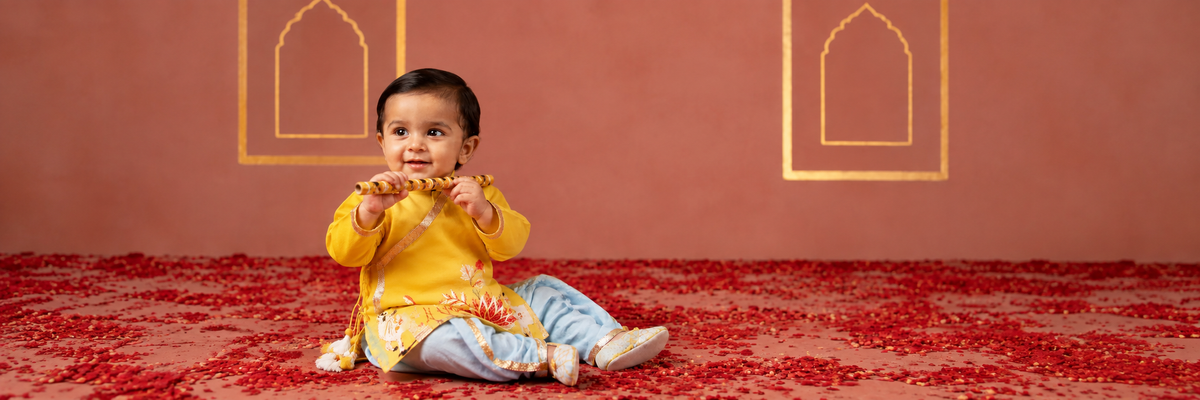
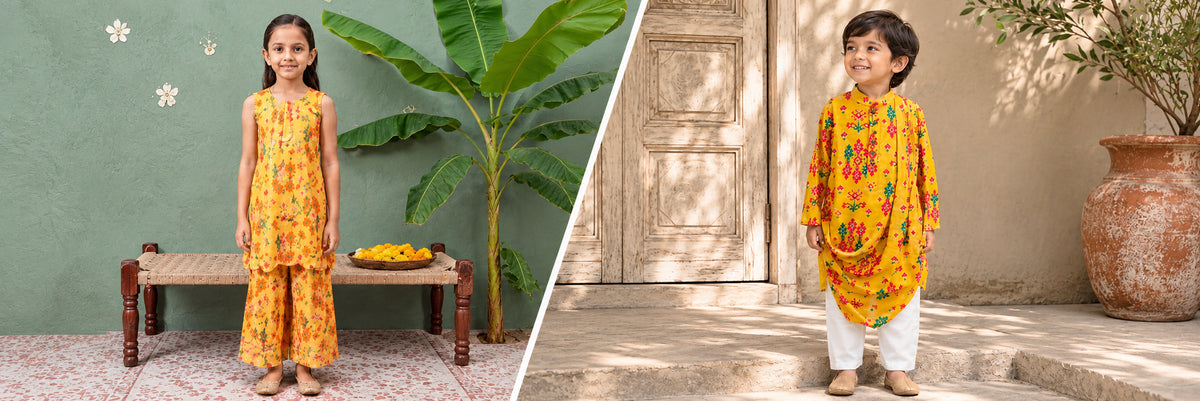
A baby brother in a soft jamna set and his older sister in a lehenga can look beautifully coordinated simply by sharing a colour palette. A shade of yellow, a tone of green, a hint of maroon repeated across both outfits creates connection without asking either child to wear something that doesn't suit their age.
The outfit style can stay completely different. It is the colour that ties the story together.
Comfort Comes First for the Little One
An infant does not experience a celebration the way an older sibling does.
Babies spend most of the day being carried, cuddled, and passed gently between family members. They cannot adjust an uncomfortable collar or loosen a tight sleeve on their own.
This is why the baby's outfit should always be the simplest part of the pairing. Soft fabrics, gentle stitching, and breathable layers matter far more than heavy embellishment.
A relaxed baby is usually a happy baby. And a happy baby makes the whole celebration easier for everyone.
Give the Older Sister Room to Move and Play
While the baby is being held close, the older sister is usually somewhere else entirely.
She is running between cousins. She is dancing near the DJ. She is twirling just to watch her lehenga move with her.
Her outfit needs to keep up with that energy. A well-fitted lehenga or ghagra that allows easy movement will always photograph better than one that restricts her, simply because she will look like herself in it, joyful and free.
Matching does not mean asking her to sit still and pose. It means dressing her in a way that lets her be exactly who she is that day, just in coordinated colours.
A Shared Detail Can Say More Than a Full Match
Sometimes the smallest details create the strongest connection.
A dupatta in the same shade as the baby's jamna. A matching border along the hem of both outfits. A single motif, like a small floral print, appearing on both children in different ways.
These subtle touches often feel more elegant than a complete matching set, since they leave room for each outfit to suit the child wearing it.
A little repetition goes a long way. It doesn't need to shout to be noticed.
Every Family Celebration Has Its Own Colour Story
Every occasion tends to carry its own natural palette.
Diwali often calls for warm golds, maroons, and deep oranges, the kind of colours that glow beautifully against string lights and diyas. Janmashtami feels right in soft yellows and blues, especially with a Krishna-inspired touch on the baby's jamna. Navratri leans playful, with brighter pinks and oranges that suit the energy of the dandiya floor. And on Raksha Bandhan, a coordinated look between brother and sister adds a quiet meaning of its own, since the day is already about the bond between them.
Choosing sibling outfits within that natural colour story makes styling far simpler, since both children's outfits will already feel connected to the occasion itself, not just to each other.
The celebration sets the palette. The siblings simply follow it, together.
Weddings Bring Their Own Styling Rhythm
Weddings rarely stop at one outfit.
There is the haldi, soft and yellow. The mehendi, leaning green with a touch of mirror work. The sangeet, brighter and more playful, built for dancing. And the wedding day itself, which usually calls for something richer, a deep red, maroon, or royal blue that feels appropriately celebratory.
Planning sibling outfits across these functions becomes far easier once a simple colour thread runs through all of them, even if the specific outfit changes from a jamna set to a lehenga to a sherwani-style ensemble as the days go on.
It doesn't need to be elaborate. It just needs to feel considered, function after function.
The Photograph That Captures More Than an Outfit
Years later, nobody remembers the exact shade of yellow or the specific embroidery pattern.
What they remember is the way the older sister looked at her baby brother that day. The way she held his hand. The way both children, dressed thoughtfully in complementary colours, looked like they truly belonged to each other.
That is what sibling matching outfits are really meant to capture. Not perfection. Just closeness, dressed beautifully for the occasion.
A Little Note for Parents
Dear Parents,
When dressing your children for a celebration, remember that the bond between them matters far more than the exact match of their outfits. Choose colours that feel joyful together, keep your baby comfortable, and let your older child move freely. The rest will fall into place on its own. Years from now, it will not be the outfit you remember most. It will be the way your children stood together, dressed with love, on a day worth celebrating.
-
P&S Co